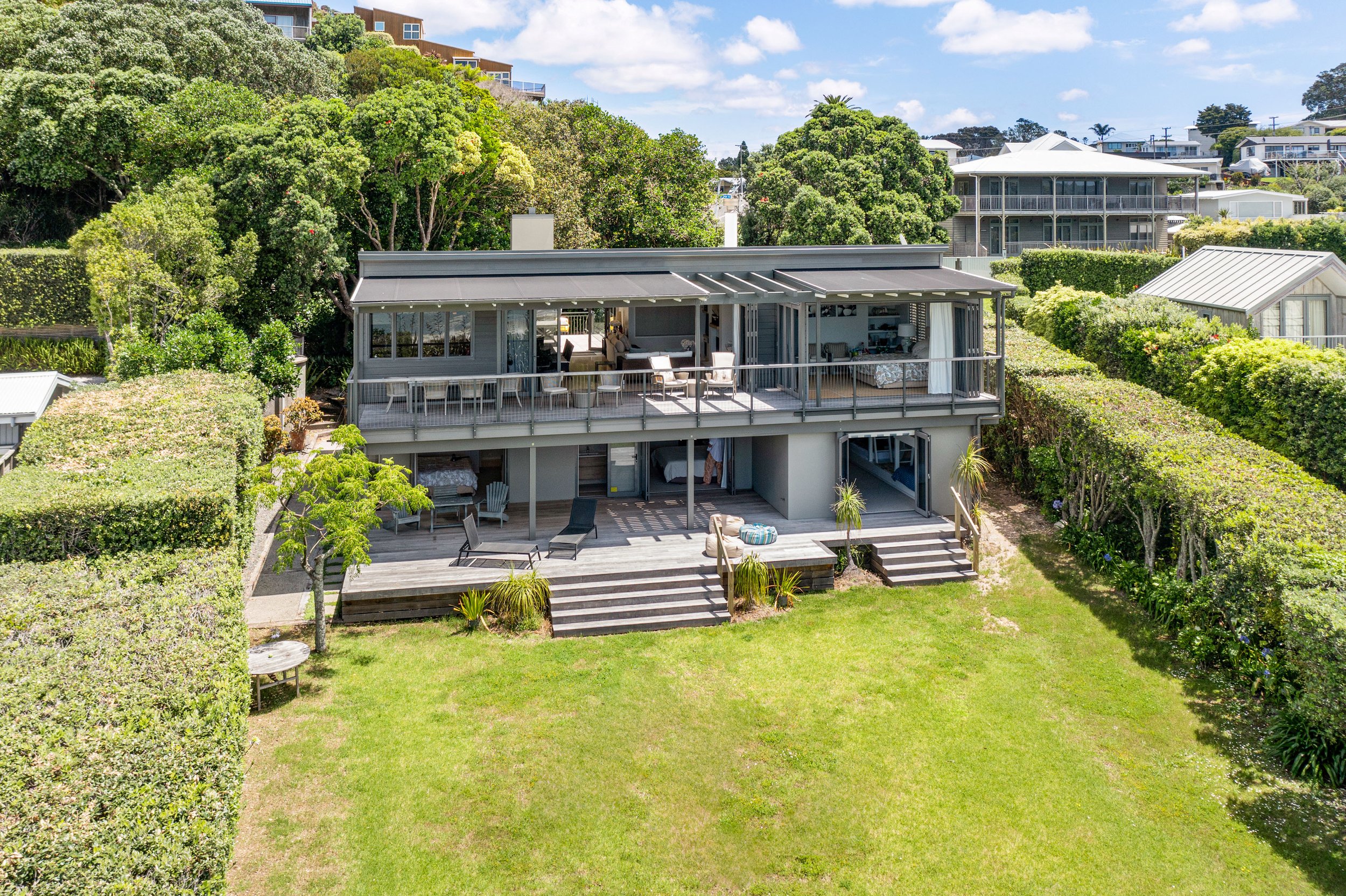
On Purangi Road in Cooks Beach, Paterson Construction renovated a 4-bedroom, 2-bathroom beachfront home that looks straight out over the water. The goal was simple: open the home up to the view and the light, and make sure it stands up to life right on the coast. Here's what we did, and what it shows about renovating a beachfront home.
The Purangi Road project
| Detail | Purangi Road |
|---|---|
| Location | Purangi Road, Cooks Beach |
| Type | Beachfront renovation |
| Home | 4 bedrooms, 2 bathrooms |
| Builder | Paterson Construction |
Opening the home up to the view
We reworked the home to open up the living area and refresh the kitchen, so both make the most of the outlook and the light. Now:
- The kitchen has wraparound corner windows looking out to the sea and the cliffs, with an island bench at its centre.
- The living and dining area opens fully onto the deck and the sea view.
- A covered deck with a timber ceiling looks over the lawn to the sea and headland.
- Bedrooms open onto the lawn and deck, with floor-to-ceiling glass facing the water.
- A kids' bunk room has built-in bunks, a window seat and doors to the garden.
- A tiled terrace with an outdoor fireplace adds another place to sit outside.
See the full photo set on the Purangi Road project page.
Built for direct coastal exposure
Beachfront sites are unforgiving. On this renovation, every exterior decision, from the cladding to the joinery to the fixings, was specified for direct coastal exposure, so the house will hold up as well in 10 years as it does today.
Why the coast is so hard on a house
BRANZ explains that chlorides from sea salt are the main cause of metal corrosion in New Zealand buildings, and that salt can be carried more than 20 km inland. The timber-framing standard NZS 3604 sorts sites into exposure zones:
| Zone | Risk from wind-blown sea salt | Where |
|---|---|---|
| B | Low | Inland areas |
| C | Medium | Inland coastal areas with relatively low salinity |
| D | High | Within 500 m of the coast including harbours, 100 m from tidal estuaries and sheltered inlets, and all offshore islands |
The Building Code's Acceptable Solution E2/AS1 also has a Zone E for severe marine sites: breaking-surf beachfronts. The closer you are to the water, the tougher the fixings, cladding and joinery need to be.
Lessons for your beachfront renovation
- Check your exposure zone before choosing materials. It sets the minimum standard for fixings and more.
- Open up to the view, but plan for weather. A covered deck and sheltered outdoor spaces let you use them on windy days.
- Specify the whole envelope for the coast, from cladding and joinery to the smallest fixings.
- Think about who stays. A bunk room is an efficient way to sleep extra family at a holiday home.
- Check the coastal rules. Beachfront sections can be affected by the council's coastal hazard rules. Read our guide to coastal erosion and building rules at Cooks Beach.
Common questions
What exposure zone is a beachfront home in NZ?
Under NZS 3604, all areas within 500 m of the coast are Zone D, the high-risk zone. Breaking-surf beachfronts can fall into Zone E under the Building Code's E2/AS1.
Do coastal homes need stainless steel fixings?
Sites in the higher-risk coastal zones need more corrosion-resistant fixings. Your designer and builder should specify them to suit your exposure zone.
Can you open up an older beach house?
It depends on the house. Removing a load-bearing or braced wall needs a building consent and an engineered replacement, so get it checked first. Read our guide to open-plan living and renovation.
Renovating a beachfront home?
Paterson Construction is a Cooks Beach building company that renovates and builds homes right on the coast. Talk to Dave about your beachfront renovation.
How we put this guide together: the project details come from our Purangi Road project page and photos, and the coastal exposure information from BRANZ, checked in November 2026.